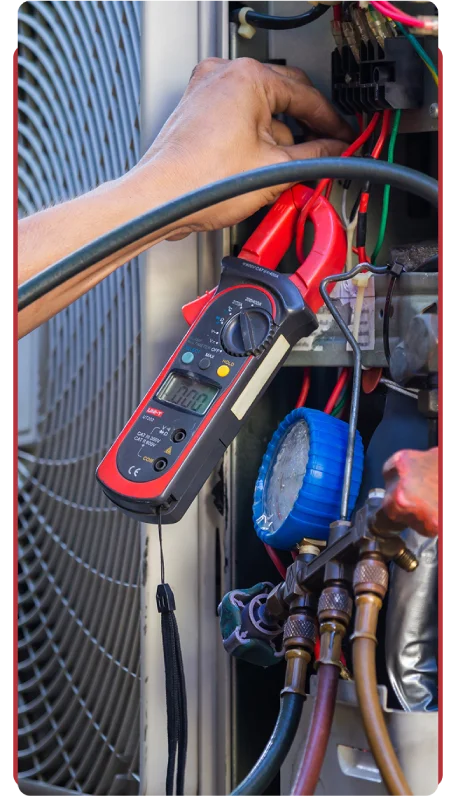
Your air conditioner broke down in the heat of summer, and you need it fixed now—not next week. J&G Heating & Air Conditioning dispatches NATE-certified technicians to homes across Lancaster County for same-day diagnosis and repair. We’ve been fixing cooling systems since 1997, and we know how to pinpoint problems quickly, explain what’s wrong, and get you back to cool, comfortable air.
Why Lancaster Homeowners Trust J&G Heating & Air Conditioning for AC Repair
When your air conditioning system breaks down in the middle of summer, you need a contractor who responds fast, diagnoses accurately, and fixes the problem right the first time. Our NATE-certified technicians have the experience and tools to handle any repair—from simple capacitor replacements to complex refrigerant leak repairs.
Get Your AC Repair Started
What Sets Our AC Repair Apart?
Your cooling system failing in July is an emergency—we treat it that way. Call during posted emergency hours (Mon–Sun, 6 AM–10 PM, after-hours fee applies) and our dispatch team finds the nearest available technician. Most emergency calls are answered within hours, not days. You get a real person on the phone, not an automated system.
Our technicians hold NATE certification in air conditioning, which means they’ve passed rigorous exams on refrigerant safety, electrical codes, compressor diagnostics, and system troubleshooting. When a technician arrives at your door, they bring years of hands-on experience diagnosing problems others can’t find. We don’t guess; we measure, test, and verify before recommending a repair.
When your AC breaks down, you’re vulnerable—you want cold air, and you’ll pay for it. We don’t exploit that. Our technicians assess whether your system can be repaired affordably or if replacement makes economic sense. We’ll tell you the truth: sometimes a straightforward repair extends your system’s life another 5 years; sometimes continuing to repair a 15-year-old unit costs more than a new installation. We respect your budget and give you options.
We’ve served Lancaster County families and businesses for nearly 30 years. That longevity means we take reputation seriously—we want your next call to be a maintenance appointment, not another desperate repair. Emergency service is available Mon–Sun, 6:00 AM–10:00 PM (after-hours fee applies), including weekends and holidays. You’re not calling a national call center; you’re calling the people who know your community.
Whether your system is a Heil, Fujitsu, Burnham, or an older unit we didn’t install, we repair it. We stock common parts (capacitors, contactors, refrigerants, compressors) at our shop and in service trucks, so we can often fix your system same-day without waiting for parts.
You’ll never be shocked by an invoice. We quote repair costs upfront, explain what’s included, and discuss your options before we start work. No hidden trip fees, no inflated labor hours, no pressure to upsell parts you don’t need.
Our Service Areas
Emergency AC Repair Across Lancaster County
J&G Heating & Air Conditioning provides same-day AC repair across five communities in Lancaster County. No matter where you live, our emergency dispatch team can send a technician to diagnose and repair your system fast. We keep mobile service trucks stocked with common repair parts, so most jobs are completed the same day you call.
Communities We Serve:
Same-day emergency repair dispatch during posted emergency hours. Our primary service area with the fastest response times from our main office in Conestoga. Quick diagnostics and same-day repair for most issues. More about Lancaster AC service →
Emergency repair within 2–4 hours during posted emergency hours. Located just 10 minutes east of our office, Denver gets our fastest response times. We’ve serviced hundreds of systems in this area and stock local experience. More about Denver AC service →
Repair service during posted emergency hours (Mon–Sun, 6:00 AM–10:00 PM, after-hours fee applies). Northeast Lancaster County coverage by our most experienced technicians. Emergency calls answered with rapid dispatch during those hours. More about Ephrata AC service →
Same-day repair response on Route 30 corridor. South Lancaster service with full diagnostic and repair capabilities. We handle emergency calls and routine repairs with equal urgency. More about Columbia AC service →
Emergency repair service during posted emergency hours. North-central Lancaster County, served by technicians familiar with the neighborhood’s homes and systems. Fast dispatch and honest, transparent repair estimates. More about Lititz AC service →
Warning Signs
Warning Signs Your AC Needs Repair
Don’t wait for a complete breakdown. These warning signs indicate your air conditioning system needs professional attention before it fails completely.
AC Won’t Turn On or Powers Down Immediately
If your thermostat says cool but the outdoor unit doesn’t hum to life, the problem could be a tripped circuit breaker, a blown contactor (an electrical switch that engages the compressor), a refrigerant leak that triggered a low-pressure shutoff, or a thermostat control wire disconnected during past work. Don’t assume it’s a big problem—sometimes it’s a simple part. Other times it signals a compressor failure brewing inside. We’ll diagnose which one during your service call.
Weak or Warm Air Blowing from Vents
Your system is running, but the air coming out of your registers feels room-temperature or only slightly cool. This usually means low refrigerant (a leak somewhere in the line set), a frozen evaporator coil (caused by restricted airflow or moisture in the system), a failed expansion valve that won’t meter refrigerant correctly, or a blower fan that’s running but not pulling air through the ducts. We check filters, test for leaks using special dyes, measure refrigerant pressure, and inspect coil temperature to nail down the cause.
Refrigerant Leak or Hissing Sounds
A hissing or bubbling noise near the indoor or outdoor unit, or oily residue on copper tubing, signals a refrigerant leak. Refrigerant is expensive and heavily regulated under EPA law. Leaks don’t fix themselves and will get worse over weeks. We locate leaks using electronic detectors and dye tracers, repair the joint or component, vacuum out air and moisture, and recharge with the correct refrigerant type and amount.
Outdoor Unit Not Running or Making Grinding Sounds
The outdoor condenser fan should spin when your thermostat calls for cooling. If it’s silent, you have a fan motor failure, a contactor that won’t engage, or a broken run capacitor (a small cylindrical part that stores electrical charge to start the fan). Grinding or squealing from the outdoor unit warns of bearing wear in the fan motor or compressor—these are urgent signs that parts are about to fail. We arrive with replacement capacitors, contactors, and fan motors in the truck and can often have you running again within hours.
High Energy Bills with No Change in Usage
A sudden spike in cooling costs often means your system is running longer than normal because it’s not cooling efficiently. Causes include low refrigerant (leak), a dirty condenser coil (restricts heat rejection), a seized compressor starting to seize (drawing extra amps), or a failed thermostat that won’t cycle the system off. We review your utility bills, test amp draw on the compressor, and inspect coil cleanliness to identify where efficiency has dropped.
Water Pooling Inside or Around Your Home
If you see water near the indoor unit, in your attic, basement, or crawlspace, your condensate drain line is clogged. AC systems produce water as a byproduct of cooling. That water must drain away; if the line clogs with algae, debris, or ice, it backs up and can damage insulation, drywall, or electrical components. We clear the drain line, flush it with biocide to prevent algae, and ensure proper slope so it never backs up again.
Our Process
Our AC Repair Process
Every AC repair we do follows the same proven diagnostic process—designed to identify the problem quickly and fix it right the first time. Tap any step below to see exactly what happens.
You call or book online, and our dispatch team notes your address, describes the problem (AC won’t start, weak cooling, strange noise), and gives you a time window. We prioritize emergency calls—compressor failures and refrigerant leaks get fastest response. Our technician arrives with a fully stocked service truck carrying capacitors, contactors, fan motors, refrigerants, and diagnostic tools. They introduce themselves, wash their hands, and ask to see where the indoor and outdoor units are located.
Take your description and log the call with your address and service history if you’re an existing customer
Dispatch the nearest available technician from our fleet
Technician arrives within 2–4 hours for emergency calls, sometimes same-day for routine repairs
Technician reviews your account, previous repairs, and brand/model of your system before arriving
The technician visually examines both the indoor and outdoor units for obvious signs: loose wires, corrosion on electrical connections, moisture pooling near the indoor coil, debris clogging the outdoor condenser, or a thermostat that’s unresponsive. They use a multimeter to test voltage at the thermostat, contactor, and compressor to confirm power is reaching where it should. They feel the refrigerant lines (hot outdoor line, cold indoor line) to gauge if refrigerant is circulating. This rapid triage often reveals the problem in the first 10 minutes.
Visually inspect indoor and outdoor units for obvious damage, corrosion, or loose components
Use multimeter to test voltage at thermostat, contactor, capacitor, and compressor
Feel temperature of refrigerant lines to assess if system is actively circulating refrigerant
Check filter status and coil cleanliness from outdoor inspection
Note any unusual odors, sounds, or signs of previous repairs
If the visual inspection doesn’t reveal the problem, the technician connects a refrigerant gauge set (a diagnostic tool with pressure gauges for both high and low sides of the system). Normal pressure readings vary by ambient temperature and system design, but abnormal readings instantly signal problems: too-low pressure suggests a leak or low charge; too-high pressure suggests a clogged condenser or air in the system. The technician compares readings to manufacturer specs and your system’s design pressure. They also measure the temperature at the outdoor condenser to calculate superheat and subcooling—precise metrics that reveal whether refrigerant is being metered correctly.
Connect low-side and high-side pressure gauges to refrigerant ports and record baseline pressures
Compare readings against manufacturer specifications for your system design and ambient temperature
Measure temperature at the evaporator coil (indoor) and condenser (outdoor) to calculate superheat and subcooling
Listen for unusual compressor noises or vibrations that signal internal damage
If low pressure is detected, perform a nitrogen pressure test to check for leaks in joints and tubing
If refrigerant pressure is low, the technician performs a leak test. They use an electronic refrigerant detector (sensitive enough to find pinhole leaks) and may add a fluorescent dye tracer to the system to make leaks visible under UV light. Common leak sites include the brazing joints where copper tubing connects to the coil, the schrader valve stems (service ports), and micro-cracks in the tubing caused by vibration or manufacturing defects. Once located, leaks are repaired by re-brazing the joint or replacing the damaged component. For electrical issues, they test capacitors with a dedicated capacitor tester, check contactor continuity, and test thermostat control wiring for breaks or shorts.
Apply electronic leak detector to all accessible refrigerant tubing and joints to locate breaches
Inject fluorescent dye tracer if leaks are suspected but not immediately found; use UV light for follow-up inspection
Test run capacitor with multimeter or dedicated capacitor tester to confirm it’s holding charge
Check contactor for pitting, corrosion, or electrical continuity—replace if failed
Test thermostat control wiring for continuity and voltage signal to confirm communication with outdoor unit
Inspect electrical connections at compressor terminals for corrosion or looseness
Once the problem is identified, the technician performs the repair. This might mean replacing a capacitor (usually 20–30 minutes), re-brazing a leaky joint (45 minutes to 2 hours depending on location and difficulty), replacing a contactor or fan motor (1–2 hours), or recovering, repairing, and recharging refrigerant. After repair, the system is started and monitored: the technician listens for normal compressor hum, verifies airflow at vents, measures coil temperature and refrigerant pressure to confirm they’re in normal range, and lets the system run for at least 15 minutes to confirm it cycles smoothly without shutdowns. They explain what they found, what they fixed, and what to watch for over the coming weeks.
Recover any refrigerant carefully if component replacement requires depressurization (EPA-required procedure for older R-22 systems)
Replace failed components using manufacturer-approved parts: capacitors, contactors, fan motors, thermostats, expansion valves, or compressors
For refrigerant leaks: repair the leak by re-brazing or component replacement, then perform nitrogen pressure test to verify the repair
Vacuum the entire system with a high-capacity pump for 20–30 minutes to remove moisture and air trapped inside
Recharge with correct refrigerant type and amount (manufacturer specification), using calibrated scales and instrumentation
Run the system through a full cooling cycle, measuring pressures, temperatures, and airflow; compare against baseline specs to confirm repair success
Explain the repair to you: what failed, why, how it was fixed, and any maintenance recommendations
Common Repairs
Common AC Repairs We Handle
Our technicians are equipped to handle all types of air conditioning repairs, from simple component replacements to complex system diagnostics.
Capacitor Replacement
Run capacitors store electrical charge to start the compressor and fan motor. They wear out and eventually fail—a dead capacitor means your AC won’t start. Replacement is straightforward and can be done in 20 minutes. We stock multiple capacitor types on our service trucks so you rarely wait for parts.
The contactor is an electrical relay that connects your thermostat’s signal to the compressor. When it fails, your system won’t respond to the thermostat. Sometimes replacing the contactor fixes it; sometimes the problem is a failed control board. We diagnose which one is failing and explain repair versus replacement trade-offs.
Refrigerant leaks are EPA-regulated and must be fixed by licensed technicians. We locate the leak, perform the repair (re-brazing a loose joint or replacing a component), and recharge the system. We guarantee the repair and test pressures to confirm the leak is gone.
The outdoor condenser fan spins to release heat from the refrigerant. If the motor seizes or bearings wear out, the fan stops, and your system overheats and shuts down. Fan motor replacement takes 1–2 hours and can often be completed same-day. We stock replacement fan motors for most major brands.
A failed thermostat won’t communicate with your outdoor unit—your system runs nonstop or never kicks on. Thermostat replacement options range from basic units to programmable and smart thermostats. We ensure the new thermostat is wired correctly and communicates with your outdoor unit before we leave.
A dirty outdoor condenser coil restricts heat rejection, forcing your compressor to work harder and consume more energy. Annual coil cleaning saves money and extends compressor life. If internal coil leaks are detected, replacement becomes necessary. We quote both cleaning and replacement options so you can choose the best path forward.
Make Your Comfort Upgrade Affordable with Flexible Financing Options
We believe every homeowner in Lancaster County deserves access to reliable heating and cooling — regardless of budget. That’s why J&G Heating & Air Conditioning partners with trusted financing providers to offer flexible payment plans that fit your financial situation. Whether you’re replacing an aging boiler, upgrading to a high-efficiency air conditioning system, installing a high-efficiency heat pump, or investing in a new generator system, financing allows you to enjoy the comfort you need today while spreading payments over time.
Our team will walk you through every available option during your free estimate, helping you understand monthly payment amounts, interest rates, and approval requirements. We want the financial side of your project to feel just as comfortable as the temperature in your home.
What Are the Benefits of Financing?
Keep your emergency fund intact while still investing in a high-quality HVAC system. Financing lets you upgrade your comfort without depleting your savings account, giving you financial flexibility and peace of mind.
Don’t wait for your next paycheck or tax return. With financing in place, you can replace an aging system or upgrade today — and start enjoying reliable comfort right away.
Financing puts higher-efficiency equipment within reach. Better systems mean lower energy bills, longer equipment life, and more reliable comfort — benefits that pay off year after year.
Fixed monthly payments make it easy to budget for your project. No surprises, no hidden fees — just a clear path to comfort that fits your household’s finances.
Wells Fargo
As an authorized Wells Fargo financing partner, J&G Heating & Air Conditioning offers a range of credit options to help you manage the cost of your new heating or cooling system. With competitive rates and flexible terms, qualifying homeowners can enjoy convenient monthly payments that fit comfortably into their household budget.
Through our partnership with PowerPay, we provide another trusted financing pathway for Lancaster County homeowners ready to upgrade their home comfort. PowerPay’s streamlined application process and flexible repayment plans make it easy to get started on your project without delay.
GoodLeap offers flexible financing options and competitive rates, making it easy for homeowners to invest in high-efficiency heating, cooling, and generator systems. With a simple application process and a variety of repayment terms, upgrading your home comfort doesn’t have to mean a large upfront cost.
When you join one of our maintenance programs, you’ll receive scheduled tune-ups performed by our NATE-certified technicians who know your system inside and out. We’ll clean critical components, check refrigerant levels, inspect electrical connections, test safety controls, and ensure everything is operating as it should.
Regular maintenance doesn’t just prevent breakdowns — it also helps lower your energy bills and protects your manufacturer warranty coverage. It’s one of the smartest investments you can make in your home’s comfort and your family’s safety.
Our Maintenance Plans Include:
Receive professional inspections and tune-ups for your heating and cooling systems each year, ensuring your equipment is ready before the season’s first extreme temperature day.
As a maintenance plan member, your service requests jump to the front of the line — so you spend less time waiting on a fix and more time enjoying a comfortable home.
A clean, well-tuned system uses less energy to deliver the same comfort. Members typically see lower monthly utility bills and a smaller carbon footprint year-round.
Catching small issues early prevents major breakdowns and extends the life of your HVAC equipment — protecting both your comfort and your investment.
For emergency calls, we aim for 2–4 hours same-day. If you call early morning, same-day is typical. Weekend and holiday emergencies are answered by our on-call technician. Non-emergency repairs can usually be scheduled within 24–48 hours depending on our queue.
Repair costs depend on what’s broken. Some repairs like capacitor replacement are straightforward; others like refrigerant leak repairs or compressor replacement are more involved. We quote upfront after diagnosis so you know the cost before we start work. We always discuss whether repair or replacement makes sense for your age of system.
Yes. Parts carry manufacturer warranty (usually 1–5 years depending on the component). Our labor is backed by a 1-year satisfaction guarantee. If something we fixed fails again due to workmanship, we’ll come back and make it right at no charge.
That depends on the repair cost and your system’s condition. If the repair is straightforward and the system has been reasonably reliable, repair makes sense. If you’ve had multiple repairs in the past few years or if parts are becoming harder to source, replacement may be more economical long-term. We’ll give you an honest assessment and let you decide.
Leaks form at brazing joints where copper tubing connects, at schrader valve stems (service ports), or from micro-cracks in tubing caused by vibration or manufacturing defects. Leaks don’t heal themselves—they get worse. Once detected, they must be repaired by a licensed technician and the system recharged with new refrigerant.
Absolutely. We service all major brands: Heil, Fujitsu, Carrier, Trane, Lennox, Goodman, and others. We stock parts and refrigerants for all of them. Our technicians are brand-agnostic and excel at diagnosing problems across different systems.
Possible causes: low refrigerant (leak), frozen evaporator coil (restricted airflow), dirty condenser (outdoor unit), failed expansion valve, or weak blower motor. We test pressures, check airflow, inspect coils, and measure temperature differential across the indoor coil to pinpoint the cause. It’s rarely a mystery once we run diagnostics.
A slight hum and whoosh from airflow is normal. Grinding, squealing, hissing, or banging noises are not—they signal a problem. Grinding means compressor bearing wear; squealing means belt or fan bearing wear; hissing means refrigerant leak; banging means a component is vibrating loose. Call us immediately if you hear unusual sounds.
Emergency service is available Mon–Sun, 6 AM–10 PM (after-hours fee applies outside regular business hours), including Saturdays. Call 717-872-6994 during those hours and our dispatcher will send a technician.
A repair call is diagnostic and fixes a specific problem—your system isn’t working and we get it running again. A maintenance tune-up is preventive—we clean coils, check refrigerant, test all electrical connections, replace filters, and identify potential problems before they break down. Maintenance prevents costly emergency repairs.
Don’t Wait in the Heat
Don’t Wait in the Heat
Your AC breaking down in July is an emergency—and we treat it that way. J&G Heating & Air Conditioning has served Lancaster County families and businesses for nearly three decades with honest diagnostics, transparent pricing, and same-day repair service. When your system goes down, we show up fast, fix it right, and stand behind the work.
Maintenance prevents emergencies. Join our customers who schedule annual tune-ups before summer arrives. An investment in maintenance now saves thousands in emergency repairs later. Join our maintenance plan for automatic seasonal tune-ups and priority emergency service.
Annual tune-ups catch problems early, extend system life, and keep efficiency high. One maintenance appointment per year can prevent emergency repairs.
Cold season furnace breakdowns follow the same emergency model. Emergency furnace repair available during posted emergency hours across Lancaster County.