Keep Your Heat Pump Running Efficiently Year-Round in Lancaster, PA
Your heat pump handles both heating in winter and cooling in summer—the maintenance it receives directly impacts comfort, efficiency, and how long it lasts. J&G Heating & Air Conditioning provides comprehensive annual heat pump maintenance and seasonal tune-ups to catch small problems before they become expensive repairs. With regular maintenance, your heat pump stays efficient, your utility bills stay lower, and emergency breakdowns become rare.
Heat pumps don’t fail without warning. Refrigerant pressure slowly drops weeks before you notice weak heating. Defrost sensors gradually drift out of calibration. Capacitors age silently until they fail mid-season. Annual maintenance includes pressure testing, sensor verification, and electrical testing that reveals developing problems while they’re still small and inexpensive to fix. A routine maintenance appointment can prevent expensive emergency repair calls.
Pennsylvania’s climate demands attention. Before winter, we verify that your reversing valve switches smoothly, defrost logic engages properly, and electric heating is set to activate only during extreme cold. Before summer, we confirm outdoor coil cleanliness, charge levels, and cooling capacity. Commissioning twice yearly ensures you’re getting peak efficiency when you need it most—during heating season and cooling season.
Outdoor coils accumulate dust, pollen, and debris throughout the year. Dirty coils reduce heat transfer and force your compressor to work harder, consuming more electricity. Indoor coils harbor mold and dust that recirculate through your home. We clean both coils annually—a simple procedure that restores efficiency by 10–15% and improves air quality. This cleaning is the most cost-effective efficiency upgrade available.
Lancaster County’s summer humidity and winter temperature swings create specific stresses on heat pump systems. We understand the local climate and what to look for: excessive frost on the outdoor coil during heating, condensate backup during humid summers, and defrost cycling that consumes energy. Our maintenance procedures are tuned to your regional climate challenges.
We’ve serviced heat pumps in Lancaster County for 29+ years. When you schedule maintenance with J&G Heating & Air Conditioning, you’re building a service relationship with technicians who know your neighborhood, your climate, and your equipment. We remember your system and its service history, so future repairs are faster and more accurate because we know what’s already been done.
Join our maintenance plan and you’ll receive scheduled inspections, parts discounts, and priority response when repairs are needed. Plan members avoid emergency call surcharges and get priority scheduling during peak season. The annual cost of a plan is recovered in just one or two avoided emergency calls.
Our Service Areas
Heat Pump Maintenance Service Areas Across Lancaster County
J&G Heating & Air Conditioning provides seasonal maintenance and tune-up service throughout Lancaster County. We schedule appointments during fall and spring transition periods—ideal times to prepare your system for the coming season. Our technicians understand Lancaster County’s unique climate stresses and what to look for in your specific neighborhood.
Communities We Serve:
Comprehensive heat pump maintenance with scheduling based on your preference. Our primary service area with extensive experience serving Lancaster neighborhoods and their climate challenges. More about Lancaster heat pump service →
Seasonal heat pump commissioning and annual tune-ups. Just 10 minutes east of our office. Technicians familiar with northeast Lancaster County weather patterns and system performance expectations. More about Denver heat pump service →
Professional maintenance service focused on seasonal preparation and efficiency optimization. Northeast area expertise with deep knowledge of heating and cooling seasons in this region. More about Ephrata heat pump service →
Heat pump maintenance and seasonal commissioning south of Lancaster on Route 30. Community-focused service with consistent technician continuity and detailed service history documentation. More about Columbia heat pump service →
Annual maintenance, coil cleaning, and seasonal tune-ups for north-central Lancaster County. Experienced technicians provide reliable preventive care to extend system life and optimize comfort. More about Lititz heat pump service →
Our Process
Our Heat Pump Maintenance & Seasonal Commissioning Process
Every heat pump maintenance we do follows the same proven process — designed to deliver optimal performance, catch developing problems early, and prepare your system for the coming season. Tap any step below to see exactly what happens.
Before the technician arrives, we review your system’s service history, any prior repairs, and your comfort concerns from the past season. We ask: Did you notice weak heating last winter? Any frost buildup on the outdoor unit? Were there temperature swings between rooms? Did your electric heating run constantly? This history shapes our inspection priorities. For first-time maintenance, we establish a baseline understanding of your system’s condition and set expectations for performance throughout the year.
Review your system’s service history and prior repair documentation
Document any comfort complaints: weak heating, weak cooling, high electric bills, strange noises
Confirm outdoor unit accessibility and identify any obstructions (snow, landscaping, debris)
Note outdoor temperature on arrival so we can compare against expected performance
Ask about usage patterns: how many people in the home, do you adjust thermostat when away, what are your comfort preferences
Our technician visually inspects the outdoor unit for debris, corrosion, loose wires, refrigerant leaks, or signs of physical damage. They clear any leaves, dirt, or obstructions blocking airflow around the unit. If the coil is visibly dirty, algae-covered, or clogged with pollen (especially common in spring after heating season), we perform a thorough coil cleaning using soft brushes and appropriate cleaning solution. A clean outdoor coil is essential for efficient heat transfer—both in heating mode (where the outdoor coil becomes the evaporator and must absorb cold) and cooling mode (where it’s the condenser and must reject heat).
Visually inspect outdoor unit for frost buildup, loose connections, or corrosion
Clear debris, leaves, and obstructions that restrict airflow around the condenser
Clean outdoor coil using soft brushes and approved cleaning solution to remove pollen, dust, and algae
Inspect refrigerant lines for signs of leaks: oily residue, discoloration, or corrosion
Verify outdoor unit is level and secure on its mounting pad
Check electrical disconnect switch and verify it’s accessible and properly labeled
The technician inspects your indoor air handler or coil unit for water leaks, mold growth, or blockages. They check the air filter condition (we typically replace it during maintenance) and inspect condensate drain lines—clogged drains cause water to back up inside your home. They verify thermostat display is responsive, batteries are fresh, and the system correctly switches between heating and cooling modes. If you have a programmable or smart thermostat, we review your setpoints and suggest energy-saving schedule adjustments.
Visually inspect indoor air handler unit for water damage, mold, or corrosion
Check filter condition and replace if clogged or dirty
Clear condensate drain lines to prevent water backup inside the home
Test thermostat responsiveness and verify mode switching (heating to cooling and back)
Replace thermostat batteries if needed
Review thermostat programming and suggest setpoint adjustments for energy savings
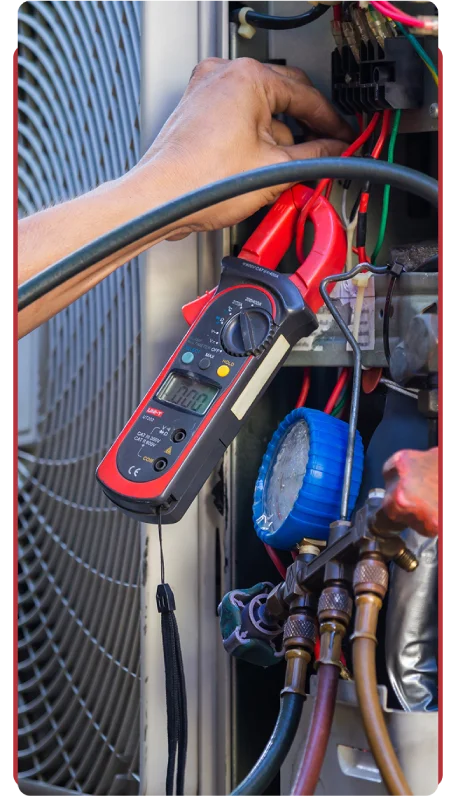
The technician connects digital gauges to your system’s service ports and records refrigerant pressures while the system runs in both heating and cooling modes. They compare readings against manufacturer specifications for your system size and ambient temperature. If pressure is low (indicating a possible refrigerant leak), we perform an electronic leak detection test on all joints and line runs. If pressure is correct, we calculate superheat and subcooling to confirm the charge level is optimal. Pressure testing takes 20–30 minutes but reveals whether your system is operating efficiently or whether a refrigerant issue is developing.
Connect low-side and high-side pressure gauges to service ports
Record baseline pressures in heating mode (outdoor coil should be cold, acting as evaporator)
Record baseline pressures in cooling mode (outdoor coil should be hot, acting as condenser)
Compare against manufacturer specifications for your system and ambient conditions
Calculate superheat and subcooling to verify proper refrigerant metering
Perform electronic leak detection if pressure is below normal range
Document findings for your records and discuss any concerns
The technician uses a multimeter to verify proper voltage at the thermostat (typically 24V AC), contactor (should energize when thermostat calls for heating or cooling), and compressor circuit. For heat pumps, they specifically test the reversing valve solenoid voltage to ensure it receives the signal to switch between heating and cooling modes. They test run and start capacitors with a dedicated tester and visually inspect contactors for pitting or corrosion that indicates electrical arcing. Safety controls (high-pressure cutout, low-pressure cutout, thermal overload) are verified functional. Proper electrical operation is critical—degraded contacts or failed capacitors cause system inefficiency or failure.
Test voltage at thermostat control transformer (should read 24V AC, stable)
Measure voltage to contactor coil when thermostat calls for heating or cooling
Test reversing valve solenoid voltage and listen for solenoid click during mode switching
Test run capacitor with dedicated capacitor tester; replace if out of specification
Inspect start capacitor condition and test if accessible
Check contactor electrical contacts for pitting or corrosion that indicates arcing
Verify all safety control switches (pressure, thermal) are responsive
During heating season maintenance (fall/winter), we specifically test your heat pump’s defrost cycle. When outdoor temperature is cold enough and outdoor coil frost begins accumulating, the defrost system should automatically initiate. We observe the cycle: the thermostat switches to cooling mode momentarily, the reversing valve clicks (reversing refrigerant direction), and hot gas flows through the outdoor coil to melt frost. The cycle typically lasts 10–20 minutes, after which the system returns to heating. Defrost failures are a heat pump–specific problem that directly affects winter heating performance. If defrost is malfunctioning, your heating capacity drops and your electric auxiliary heating runs more than necessary, wasting energy.
Monitor system operation to confirm defrost initiation when frost accumulates on outdoor coil
Time defrost cycle duration (should complete within 10–20 minutes)
Verify outdoor coil temperature rises during defrost (refrigerant reversal is working)
Confirm thermostat exits defrost mode and returns to normal heating operation
Check defrost sensor responsiveness (sensors can drift out of calibration over time)
Document defrost performance for your records
Before leaving, we walk through your home and verify that you’re comfortable. We ask: Are all rooms reaching target temperature? Any cold spots or hot spots? Is the system running excessively, or is it cycling normally? Are there any strange noises during mode switching or defrost? We measure airflow at a few vent locations to confirm balanced distribution and identify any ductwork obstructions. We also discuss your recent energy bills—rising bills can indicate declining efficiency that maintenance can reverse.
Feel temperature at multiple vents and verify balanced heating/cooling throughout home
Ask about comfort in each major room (bedrooms, living areas, basement)
Listen for normal system operation: compressor hum, reversing valve click, air flowing through ducts
Measure filter condition and advise on replacement schedule (typically monthly to quarterly)
Discuss any unusual noises and determine if they’re normal or require follow-up inspection
Review recent energy bills and discuss whether usage is in line with seasonal expectations
You’ll receive written documentation of all maintenance performed: pressures recorded, components tested, parts replaced, and any concerns identified. If we found developing problems during maintenance (pressure slightly low, electrical contact deteriorating, refrigerant possibly leaking), we’ll recommend follow-up inspection timing or discuss repair options. We explain seasonal operation: when electric heat kicks in (during extreme cold), how defrost operates (normal sounds during mode switching), and what efficiency improvements you can expect if maintenance caught early problems. For maintenance plan members, we’ll schedule your next appointment before we leave.
Provide written maintenance report detailing all testing performed and results
Review findings with you and explain any developing issues identified during maintenance
Discuss seasonal operation and expected efficiency improvements from maintenance
Recommend filter replacement schedule based on home condition and usage patterns
Leave detailed contact information and mention emergency service availability
Schedule next maintenance visit (usually 6–12 months depending on season) for plan members
Answer questions about heat pump operation and efficiency optimization
We Service all of the Industries Top Equipment and Install these Trusted Brands
Make Your Comfort Upgrade Affordable with Flexible Financing Options
We believe every homeowner in Lancaster County deserves access to reliable heating and cooling — regardless of budget. That’s why J&G Heating & Air Conditioning partners with trusted financing providers to offer flexible payment plans that fit your financial situation. Whether you’re replacing an aging boiler, upgrading to a high-efficiency air conditioning system, installing a high-efficiency heat pump, or investing in a new generator system, financing allows you to enjoy the comfort you need today while spreading payments over time.
Our team will walk you through every available option during your free estimate, helping you understand monthly payment amounts, interest rates, and approval requirements. We want the financial side of your project to feel just as comfortable as the temperature in your home.
What Are the Benefits of Financing?
Keep your emergency fund intact while still investing in a high-quality HVAC system. Financing lets you upgrade your comfort without depleting your savings account, giving you financial flexibility and peace of mind.
Don’t wait for your next paycheck or tax return. With financing in place, you can replace an aging system or upgrade today — and start enjoying reliable comfort right away.
Financing puts higher-efficiency equipment within reach. Better systems mean lower energy bills, longer equipment life, and more reliable comfort — benefits that pay off year after year.
Fixed monthly payments make it easy to budget for your project. No surprises, no hidden fees — just a clear path to comfort that fits your household’s finances.
Wells Fargo
As an authorized Wells Fargo financing partner, J&G Heating & Air Conditioning offers a range of credit options to help you manage the cost of your new heating or cooling system. With competitive rates and flexible terms, qualifying homeowners can enjoy convenient monthly payments that fit comfortably into their household budget.
Through our partnership with PowerPay, we provide another trusted financing pathway for Lancaster County homeowners ready to upgrade their home comfort. PowerPay’s streamlined application process and flexible repayment plans make it easy to get started on your project without delay.
GoodLeap offers flexible financing options and competitive rates, making it easy for homeowners to invest in high-efficiency heating, cooling, and generator systems. With a simple application process and a variety of repayment terms, upgrading your home comfort doesn’t have to mean a large upfront cost.
When you join one of our maintenance programs, you’ll receive scheduled tune-ups performed by our NATE-certified technicians who know your system inside and out. We’ll clean critical components, check refrigerant levels, inspect electrical connections, test safety controls, and ensure everything is operating as it should.
Regular maintenance doesn’t just prevent breakdowns — it also helps lower your energy bills and protects your manufacturer warranty coverage. It’s one of the smartest investments you can make in your home’s comfort and your family’s safety.
Our Maintenance Plans Include:
Receive professional inspections and tune-ups for your heating and cooling systems each year, ensuring your equipment is ready before the season’s first extreme temperature day.
As a maintenance plan member, your service requests jump to the front of the line — so you spend less time waiting on a fix and more time enjoying a comfortable home.
A clean, well-tuned system uses less energy to deliver the same comfort. Members typically see lower monthly utility bills and a smaller carbon footprint year-round.
Catching small issues early prevents major breakdowns and extends the life of your HVAC equipment — protecting both your comfort and your investment.
Frequently Asked Questions About Heat Pump Maintenance
We recommend annual maintenance—ideally fall tune-up before heating season and spring tune-up before cooling season. Some high-use systems or older units benefit from semi-annual maintenance. Maintenance plan members receive scheduled inspections per their plan.
Pressure testing, electrical system verification, coil cleaning, filter replacement, refrigerant leak detection, defrost cycle verification, thermostat programming review, and a written report of all findings. The appointment typically takes 60–90 minutes.
A single maintenance visit cost varies depending on system complexity and coil cleaning needs. Maintenance plan members often pay a flat annual fee that includes scheduled visits, parts discounts, and priority repair service at better value than individual visits.
Yes. Coil cleaning restores efficiency by 10–15%. Proper charge and refrigerant pressure verification ensures optimal operation. Filter replacement improves airflow. Over a year, these improvements deliver meaningful electricity savings that easily justify the maintenance investment.
We’ll explain the issue, whether it’s urgent (immediate repair needed) or developing (monitor and repair next season), and provide repair options and costs. You’re never pressured to repair during maintenance—we present facts and let you decide.
Not always, but yes in most cases. Maintenance catches developing problems early: a refrigerant leak found during pressure testing can be repaired before charge becomes dangerously low; a failing capacitor identified electrically can be replaced before it fails suddenly; defrost operation verified before winter prevents heating loss during cold snaps. Planning repairs during maintenance is far less expensive than emergency repairs.
Yes. System performance declines gradually—you might not notice until mid-season when you’re already uncomfortable and expensive repairs are urgent. Maintenance catches efficiency loss, refrigerant leaks, and electrical degradation while the system still works acceptably.
Maintenance is preventive: inspections, testing, cleaning, and component verification on a healthy system. Repair is reactive: fixing broken components. Maintenance prevents repairs; repairs address failures that maintenance missed or couldn’t prevent.
Both options are available. Maintenance plan members save money through included visits, parts discounts, and avoided emergency call surcharges. Non-members can request service anytime and pay per visit. Most customers find maintenance plans save money over time.
Fall (September–October) for heating season commissioning, and spring (April–May) for cooling season commissioning. Scheduling during off-peak season means faster appointment availability than during peak heating or cooling months.
Let’s Get Started
Keep Your Heat Pump Efficient Year-Round
Preventive maintenance is the best investment you can make in your heat pump. An annual tune-up costs far less than an emergency repair call and keeps your system running at peak efficiency. J&G Heating & Air Conditioning’s technicians are trained in heat pump–specific maintenance: pressure verification, refrigerant analysis, defrost cycle confirmation, and seasonal commissioning that prepares your system for extreme weather.
Start your maintenance relationship with J&G Heating & Air Conditioning today. Our maintenance plans provide scheduled tune-ups, priority repair dispatch, and parts discounts that quickly pay for themselves. Non-plan customers can schedule service anytime for a single appointment cost. Explore our maintenance plans.