Ductless System Repair When Your Mini-Split Stops Working
Your mini-split was running quietly last week. Now it’s silent. Or it’s making a new noise. Or the temperature won’t drop below 75 degrees no matter how many times you adjust the remote. A mini-split that’s not performing isn’t just uncomfortable—it’s a sign that something specific has gone wrong, and waiting only makes the problem bigger (and more expensive).
J&G Heating & Air Conditioning diagnoses mini-split failures quickly and repairs them right. Our Fujitsu and Heil certified technicians understand the refrigerant circuits, electrical controls, and compressor diagnostics that determine exactly why your system has stopped doing its job. We arrive equipped to repair most failures same-day, and emergency service is available Mon–Sun, 6:00 AM–10:00 PM (after-hours fee applies) so you’re not without air or heat during a breakdown.
Why Lancaster Homeowners Trust J&G Heating & Air Conditioning for Mini-Split Repair
When your mini-split system stops working, every hour of downtime compounds the discomfort. Don’t suffer through discomfort while waiting. Our Fujitsu and Heil certified technicians arrive equipped to diagnose and repair most failures the same day you call.
Don’t wait for complete failure. A mini-split that’s struggling—not cooling as well, making new noises, or running constantly—is warning you that something needs attention. Waiting transforms a fixable problem into a catastrophic failure.
Get Immediate Diagnosis for Your Mini-Split Problem
When your mini-split isn’t cooling or heating, every hour of downtime compounds the discomfort. Contact us immediately for fast diagnosis and repair scheduling.
What Sets Our Mini-Split Repair Apart?
A mini-split that won’t cool could be a refrigerant leak, a seized compressor, a failed capacitor, a control module failure, or a sensor malfunction. Every one costs differently and requires a different fix. We perform diagnostic testing—checking refrigerant pressures, measuring electrical continuity, scanning control codes—before we quote a repair. You’ll know exactly what’s broken and why before you authorize a single dollar of work. Honest diagnosis builds lasting relationships; surprise bills erode trust.
Our team holds manufacturer certifications from both primary brands your mini-split likely uses. Certified status means we’ve completed factory training on system architecture, refrigerant handling, electrical sequencing, and control software. When your Fujitsu head unit displays an error code, we read manufacturer diagnostics directly from the control board instead of guessing. Parts availability and warranty coverage are streamlined because our certification is documented on every repair ticket.
Capacitors, control boards, sensors, compressors, and reversing valves are failures we encounter regularly. We stock common replacement parts in our service trucks and can fix failures the same day you call. For rare or special-order components, we maintain supplier relationships that get parts overnight. Your system doesn’t stay broken while we wait for Monday shipping.
Refrigerant leaks are the single most common mini-split failure in Lancaster County—thermal cycling, vibration, and corrosion eventually create pinhole leaks in copper joints or coils. We use nitrogen-pressure testing and dye tracer methods to locate leaks precisely. Once found, we recover refrigerant using EPA-approved recovery equipment (illegal dumping is not an option we take), repair the leak by brazing the joint or replacing the failed component, and re-pressurize the system with the correct refrigerant charge.
Every repair ends with a full commissioning test—we run the system in both heating and cooling cycles, measure superheat and subcooling, verify compressor amps and pressures, and check temperature differential across the coils. You won’t get a call two days later saying “it’s acting up again.” We test until we’re certain the failure is fixed.
A mini-split failure on a Sunday in August or during a cold snap in February doesn’t wait for Monday business hours. Emergency service is available Mon–Sun, 6:00 AM–10:00 PM (after-hours fee applies) with upfront pricing before any repair starts. You control whether to proceed. Our emergency fee is transparent and listed on every call.
Our Service Areas
Mini-Split Repair Service Areas in Pennsylvania
J&G Heating & Air Conditioning responds to mini-split failures across Lancaster County with rapid diagnosis and same-day repair for most common problems. Each area receives responsive emergency service (Mon–Sun, 6:00 AM–10:00 PM, after-hours fee applies) and manufacturer-certified repair expertise.
Communities We Serve:
Our headquarters with immediate same-day and emergency response for all mini-split failures. Fastest technician dispatch and complete parts inventory. More about Lancaster mini-split service →
10 minutes away; rapid technician dispatch and parts availability for urgent mini-split repairs. Emergency service available during posted emergency hours. More about Denver mini-split service →
Serving families with expert refrigerant leak and electrical diagnostics. Complete mini-split repair capability with same-day service. More about Ephrata mini-split service →
Full repair capability for all mini-split failures and brands. Professional diagnosis and same-day repair for most common problems. More about Columbia mini-split service →
Quick response for urgent cooling or heating breakdowns. Expert mini-split repair with manufacturer-certified technicians. More about Lititz mini-split service →
Warning Signs
Warning Signs Your Mini-Split Needs Immediate Repair
Don’t ignore these symptoms—they indicate specific failures that worsen quickly without professional attention.
System Won’t Turn On or Responds Slowly
The display lights up but the outdoor unit never starts, or there’s a long delay between pressing the remote and hearing the compressor. This suggests an electrical circuit issue—burned control relay, failed capacitor, or wiring fault. The longer you wait, the more you risk permanent damage to the control board.
Refrigerant Leak: Indoor Coil Freezing
Ice forms inside the indoor unit even on cool days, or the system runs constantly but air coming from the indoor unit feels lukewarm. These are classic signs of low refrigerant charge, usually from a leak. The compressor will eventually overheat and fail if the leak isn’t found and sealed.
Strange Noises: Grinding, Rattling, or Hissing
New noises mean something has come loose or the compressor is experiencing mechanical stress. Grinding sounds indicate compressor bearing wear—a sign the system will fail within weeks. Hissing suggests a refrigerant leak. Any new sound warrants immediate inspection.
Foul Odors: Musty, Burnt, or Acidic Smell
A burnt smell from the outdoor unit suggests electrical arcing or compressor overheating. A musty smell from the indoor head unit indicates microbial growth. An acidic smell points to electrical breakdown inside the unit. Odors are your system’s way of signaling distress before failure occurs.
Frequent Error Codes or Flashing Lights
Your mini-split displays an alphanumeric code (E1, H2, P3, etc.) and the system shuts down or won’t start. These codes are diagnostic messages from the control board—they tell us exactly what component has failed. Write down every code you see and call us with that information.
Visible Water Leaks or Moisture Accumulation
Water pooling on the floor below the indoor unit or on the wall where lines pass through means the condensate drain is blocked, the line has disconnected, or the unit’s internal drain pan has failed. This seems minor until water damage spreads to flooring, insulation, or electrical wiring.
Every mini-split repair we do follows the same proven diagnostic process — designed to identify the exact failure before any repair work begins. Tap any step below to see exactly what happens.
When you call with a mini-split problem, we ask specific questions: What happened right before the failure? Are you seeing any error codes on the display? Is the outdoor unit making noise or running at all? Is air coming from the indoor unit, or is it completely inactive? These answers help us prioritize service urgency and bring the right diagnostic equipment and parts to your home. We schedule a convenient service window and provide upfront estimate of emergency fees if applicable.
Listen to your description of the problem and timeline
Ask about error codes, sounds, smells, and recent weather or usage changes
Determine whether service is routine, urgent, or true emergency
Schedule appointment within hours if emergency; next-available-day if routine
Provide upfront emergency fee disclosure for off-hours service
Our technician arrives and visually inspects both the indoor and outdoor units. We check for visible damage, corrosion, loose connections, water leaks, and obvious mechanical issues. We note the refrigerant type on the outdoor unit’s nameplate and verify it matches what’s installed. We ask you to demonstrate the problem—attempting to turn on the system, cycling modes, adjusting temperature—so we see the exact behavior. If the system is completely non-responsive, we check the electrical disconnect and circuit breaker to confirm power is reaching the unit.
Visually inspect outdoor condenser for damage, corrosion, blockages
Visually inspect indoor head unit for water leaks, ice formation, loose components
Check thermostat/remote control batteries and connection
Verify electrical disconnect is in ON position and circuit breaker hasn’t tripped
Ask you to demonstrate the problem so we see the exact failure mode
Note any error codes, warning lights, or unusual sounds during startup attempt
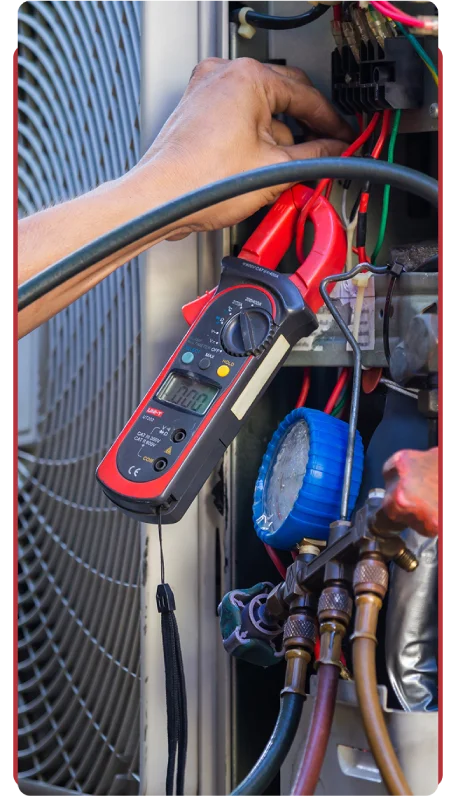
We use a multimeter to check electrical continuity and voltage at key points: the condensing unit’s power supply (should be 240V), the low-voltage control wire between outdoor and indoor units, the capacitor (stores electrical charge that helps the compressor start), and relay contacts in the control board. A failed capacitor is one of the most common mini-split failures—it prevents the compressor from starting even though power is available. A tripped thermal overload (a safety device that stops the compressor if it overheats) points to refrigerant or mechanical problems inside the compressor.
Measure voltage at the outdoor unit’s power terminals (expect 240V, +/- 10%)
Test the low-voltage control circuit between outdoor unit and indoor thermostat
Test the capacitor with a dedicated capacitor meter (failed capacitor prevents compressor startup)
Check the thermal overload switch to see if it’s tripped (thermal protection activated)
Scan the system’s internal error codes using manufacturer-specific diagnostic tools
Test all safety switches: high-pressure cutoff, low-pressure cutoff, freeze protection
If the electrical tests pass, we connect a manifold gauge to the refrigerant service ports on the outdoor unit. We read the high-side pressure (compressed refrigerant leaving the compressor) and low-side pressure (returning refrigerant entering the compressor) while the system is operating. These pressures tell us immediately if charge is correct, too low (leak), or too high (overcharge). We also measure superheat (temperature of the low-side line above saturation) and subcooling (temperature of the high-side line below saturation) to determine the exact nature of any charge problem.
Locate and access the high-side and low-side refrigerant service ports safely
Connect gauges without introducing air or moisture into the system
Record pressure readings while the system operates in cooling mode
Record pressure readings while the system operates in heating mode
Calculate superheat and subcooling values against manufacturer performance curves
If pressures are abnormal, perform nitrogen pressure tests to locate any refrigerant leaks
Low refrigerant pressure means a leak is present. We use nitrogen pressure testing (isolate with dry nitrogen at 150 psi and listen for hissing or observe bubbles in soapy water) and UV dye tracer methods. Once found, we pinpoint the leak’s exact location—typically a joint, pinhole, or coil corrosion.
Use nitrogen pressure testing to isolate leak location to a specific component
Apply soapy water around potential leak points and observe for bubbles
Use UV dye tracer: inject dye, run system, then use blacklight to spot leaks
Measure estimated refrigerant loss to determine if patch or replacement is needed
Document leak location and component serial number for warranty and parts
Once we’ve identified the failure, we execute the repair. For electrical components (capacitor, relay, control board, sensor), we de-energize the system, remove the failed part, install the matching replacement, and verify compatibility. For refrigerant leaks, we recover all remaining refrigerant using EPA-approved recovery equipment (absolutely no venting), braze the joint or replace the failed copper line or coil, evacuate all air and moisture from the system, and charge with fresh refrigerant at the correct weight and type.
De-energize the system safely by turning off the disconnect and breaker
For electrical parts: remove the failed component and install exact replacement
For refrigerant leaks: recover all refrigerant per EPA regulations
Repair brazed joints by heating and bonding new solder
Replace copper lines or coils if corrosion or damage is severe
Evacuate the system for 15–30 minutes to remove all non-refrigerant gases
Charge with correct refrigerant type and quantity per manufacturer specifications
After repair, we run the system through complete heating and cooling cycles. We measure pressures, temperatures, superheat, and subcooling again to confirm the repair was successful. We verify that airflow returns to normal, that error codes have cleared, and that the system responds correctly to thermostat changes. We listen for abnormal noises and confirm the outdoor unit operates at normal amps (electrical load). You’ll be present during testing so you see the system working properly before we leave.
Run system in cooling mode for 10–15 minutes and verify pressures return to normal
Run system in heating mode for 10–15 minutes and verify heating cycle works
Measure temperature differential across coils to confirm heat transfer
Clear all error codes from the control board and verify they don’t reappear
Test all modes: cool, heat, fan-only, and automatic
Verify thermostat responds to temperature adjustments without delay
Check outdoor unit amperage (electrical load) to confirm it’s within manufacturer spec
We leave you with a detailed repair invoice showing what failed, what we did, parts replaced, refrigerant added, test results, and warranty information. Most parts carry warranty; compressor repairs get extended coverage. We discuss root causes—deferred maintenance, defect, or wear—and recommend preventive steps: regular filter cleaning, annual maintenance, and avoiding extreme temperatures.
Provide detailed invoice with service date, technician name, and parts replaced
Explain the root cause of failure in terms you understand
Leave parts warranty information and coverage details
Recommend seasonal maintenance and cleaning schedules
Provide your personal technician contact for follow-up support
Common Repairs
Common Mini-Split Repairs We Complete
These are the most frequent mini-split failures we encounter in Lancaster County. Most can be completed same-day with parts we stock in our service trucks.
Refrigerant Leak Repair & System Recharge
A pinhole in a copper joint or coil allows refrigerant to escape, reducing cooling capacity until the system runs constantly without reaching setpoint temperature. We locate the leak using nitrogen pressure testing and UV dye tracer, repair the joint by brazing or replace the component, evacuate the system, and recharge with proper refrigerant type and weight.
The capacitor stores electrical charge that helps the compressor start and maintain torque. A failed capacitor leaves the compressor unable to start, even though power is present. We test the capacitor with a dedicated meter, confirm it’s failed, and install an exact replacement. This is often a 30-minute fix with dramatic results.
If the compressor itself has failed internally (burned windings, seized bearings, broken valves), it must be replaced. This is the most expensive repair, but sometimes cheaper and more reliable than living with an old system on borrowed time. We’ll honestly assess whether compressor replacement makes sense or whether a new mini-split installation is the better long-term investment.
The control board sequences the compressor, manages refrigerant flow, and protects the system from overload. A failed control board displays error codes and prevents the system from responding to your thermostat. We test the board’s circuits, identify the specific failed component, and either repair the board or replace it with a manufacturer-matched replacement.
Heat pump mini-splits use a reversing valve to switch between heating and cooling. If the valve sticks, the system might only heat but not cool, or vice versa. We test the valve by monitoring refrigerant flow direction, clean or replace the valve if stuck, and verify that switching between modes works smoothly after repair.
Outdoor Unit Coil Cleaning & Performance Restoration
Dirt, leaves, and debris accumulate on the outdoor condenser coil, reducing heat transfer and forcing the compressor to work harder. Cleaning the coil can restore efficiency and prevent overheating failures. We gently clean the aluminum fins with low-pressure water and a soft brush, taking care not to bend fins.
Make Your Comfort Upgrade Affordable with Flexible Financing Options
We believe every homeowner in Lancaster County deserves access to reliable heating and cooling — regardless of budget. That’s why J&G Heating & Air Conditioning partners with trusted financing providers to offer flexible payment plans that fit your financial situation. Whether you’re replacing an aging boiler, upgrading to a high-efficiency air conditioning system, installing a high-efficiency heat pump, or investing in a new generator system, financing allows you to enjoy the comfort you need today while spreading payments over time.
Our team will walk you through every available option during your free estimate, helping you understand monthly payment amounts, interest rates, and approval requirements. We want the financial side of your project to feel just as comfortable as the temperature in your home.
What Are the Benefits of Financing?
Keep your emergency fund intact while still investing in a high-quality HVAC system. Financing lets you upgrade your comfort without depleting your savings account, giving you financial flexibility and peace of mind.
Don’t wait for your next paycheck or tax return. With financing in place, you can replace an aging system or upgrade today — and start enjoying reliable comfort right away.
Financing puts higher-efficiency equipment within reach. Better systems mean lower energy bills, longer equipment life, and more reliable comfort — benefits that pay off year after year.
Fixed monthly payments make it easy to budget for your project. No surprises, no hidden fees — just a clear path to comfort that fits your household’s finances.
Wells Fargo
As an authorized Wells Fargo financing partner, J&G Heating & Air Conditioning offers a range of credit options to help you manage the cost of your new heating or cooling system. With competitive rates and flexible terms, qualifying homeowners can enjoy convenient monthly payments that fit comfortably into their household budget.
Through our partnership with PowerPay, we provide another trusted financing pathway for Lancaster County homeowners ready to upgrade their home comfort. PowerPay’s streamlined application process and flexible repayment plans make it easy to get started on your project without delay.
GoodLeap offers flexible financing options and competitive rates, making it easy for homeowners to invest in high-efficiency heating, cooling, and generator systems. With a simple application process and a variety of repayment terms, upgrading your home comfort doesn’t have to mean a large upfront cost.
When you join one of our maintenance programs, you’ll receive scheduled tune-ups performed by our NATE-certified technicians who know your system inside and out. We’ll clean critical components, check refrigerant levels, inspect electrical connections, test safety controls, and ensure everything is operating as it should.
Regular maintenance doesn’t just prevent breakdowns — it also helps lower your energy bills and protects your manufacturer warranty coverage. It’s one of the smartest investments you can make in your home’s comfort and your family’s safety.
Our Maintenance Plans Include:
Receive professional inspections and tune-ups for your heating and cooling systems each year, ensuring your equipment is ready before the season’s first extreme temperature day.
As a maintenance plan member, your service requests jump to the front of the line — so you spend less time waiting on a fix and more time enjoying a comfortable home.
A clean, well-tuned system uses less energy to deliver the same comfort. Members typically see lower monthly utility bills and a smaller carbon footprint year-round.
Catching small issues early prevents major breakdowns and extends the life of your HVAC equipment — protecting both your comfort and your investment.
Repair costs depend entirely on what failed. Simple electrical repairs like capacitor replacement are affordable. Refrigerant leak repairs vary based on leak severity and component involved. Compressor replacement is the most expensive repair but sometimes more economical than replacement. During your diagnostic call, we provide an estimate before any work begins. You decide whether to proceed.
Usually yes. Non-responsive systems are often a failed capacitor, tripped circuit breaker, or control board issue—all repairable same-day. We diagnose the problem and explain your options before the repair bill arrives. In rare cases, the compressor is internally failed and replacement is the only option.
Simple repairs like capacitor replacement take 30–60 minutes. Refrigerant leak repairs take 2–4 hours depending on leak location. Control board or compressor replacement may take a full day if parts must be ordered overnight. We provide realistic timelines during diagnosis.
The condensate drain line is blocked or disconnected. This is easily fixable—we clear the line using compressed air or drain cleaner, reconnect it if loose, and flush to confirm water flows. If ignored, water damage spreads to flooring, insulation, and electrical wiring. Don’t delay.
A compressor failure is an internal mechanical breakdown—the motor won’t turn or the compression valves are broken. It can’t be repaired, only replaced. Other failures like failed capacitors, refrigerant leaks, or control board issues can be diagnosed and fixed. We test to determine which category your problem falls into.
This depends on your system’s age, the failure type, and remaining useful life. A 5-year-old system with a capacitor failure should be repaired. A 15-year-old system with a failed compressor is often worth replacing because repairs become expensive and frequent. We’ll give you honest guidance on whether repair or replacement makes economic sense.
We charge a diagnostic fee whether you proceed with repair or not. This covers our technician’s time to test the system and identify the problem. If you authorize repair, the diagnostic fee is credited toward labor costs.
We warranty parts for 1–3 years depending on the component. If the same component fails again within warranty, we replace it at no charge. If the failure is due to a different root cause, that’s a new problem with its own diagnosis and repair cost.
Annual professional maintenance catches problems early: cleaning the outdoor coil, checking refrigerant pressure, inspecting electrical connections, testing airflow. You should clean or replace filters monthly during heavy-use seasons. This maintenance costs less than emergency repairs and extends system life significantly.
Call us immediately for emergency service (Mon–Sun, 6:00 AM–10:00 PM). We respond to urgent failures fast. You’ll pay an after-hours fee in addition to the repair cost when service is outside regular business hours, but you won’t be without heating or cooling through a dangerous night.
Don’t Wait
Don’t Wait for Your Mini-Split to Fail Completely—Call J&G Heating & Air Conditioning Today
A mini-split that’s struggling—not cooling as well, making new noises, or running constantly—is warning you that something needs attention. Waiting transforms a fixable problem into a catastrophic failure and turns an affordable repair into an expensive compressor replacement.
J&G Heating & Air Conditioning responds to mini-split failures with honest diagnosis and straightforward pricing. Our Fujitsu and Heil certified technicians carry common parts in their service trucks and complete most repairs the same day you call. We test thoroughly before declaring the repair complete, and we stand behind every fix with clear warranty coverage.